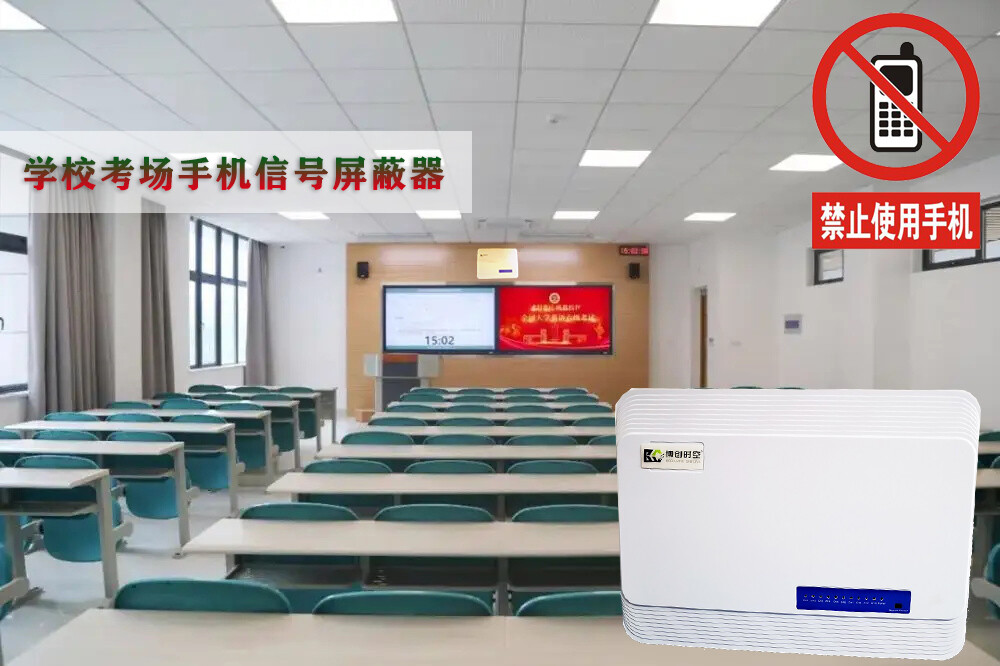
First, clarify the three objectives that exam signal shielding must achieve.
Acceptance criteria for exam jamming systems typically require three conditions to be met simultaneously: no voice, data, or hotspot sharing on devices within the venue; minimal signal disruption in adjacent areas outside the venue; and the ability to partition control, log activity, and re-verify the system.
- Not available in-storeVoice and data services from all carriers and across all terminal generations fail to establish normally in the exam venue.
- Stay within bounds off the field.Public communication in corridors outside the exam hall, adjacent floors, and surrounding roads remains unaffected.
- Manageable and ControllableEnables scheduled operation with over-temperature and VSWR protection; status is viewable.
Include these three items in the procurement and acceptance clauses to establish a basis for subsequent equipment selection and point design.
Frequency Bands: Survey first, then select equipment.
The jammer only affects the downlink frequency bands it covers. While textbook frequency tables can serve as a reference, they should not be copied directly, as actual deployed bands, network phase-out schedules, and indoor distribution systems vary by carrier and region. Common downlink bands include:
- 2G: 925–960 MHz (GSM900 downlink), 1805–1880 MHz (DCS1800 downlink)
- 3G: 2110–2170 MHz (discontinued in some regions)
- 4G: 1800 MHz, 2100 MHz, 2300 MHz, 2600 MHz, and other mainstream downlink bands
- 5G: 2500–2690 MHz, 3400–3600 MHz, 4800–4900 MHz
- Wi-Fi: 2400–2483.5 MHz, 5725–5850 MHz; Wi-Fi 6E 6 GHz band available based on local regulations
Before deployment, use a spectrum analyzer to perform a 10 MHz–6 GHz survey within the exam venue and record actual downlink levels and utilization for each carrier. If microcells or indoor distribution systems are nearby, baseline signal strength will be significantly higher; adjust power levels and site locations accordingly.
Power and Coverage: It's Not Just About Area—Structure Matters
The coverage radius is not fixed. Concrete walls, metal ceilings, fire doors, and densely packed desks all cause additional attenuation; each solid barrier can reduce signal strength by 10–20 dB. In practice, coverage is often estimated at 80–150 m² per access point, then adjusted based on field measurements.
Under the same power rating, installing devices in the center of a hallway, 3–5 m from the exterior wall and away from metal ceilings, typically provides more uniform coverage than clustering them near the podium. For large spaces, use multiple low-power units for zoned coverage rather than relying on a single high-power unit; the latter is more likely to cause signal leakage outside the venue and interference with surrounding areas.
Antenna Deployment and Leakage Control
- Ceiling-mounted omnidirectional antennas are suitable for standard classrooms with a ceiling height of approximately 3 m. Install them as close to the geometric center of the room as possible.
- Replace with directional antennas near exterior walls, windows, and ventilation shafts, with the main lobe oriented indoors.
- Independent on/off control by exam room or floor. Activate 10–15 minutes before the exam; turn off promptly afterward.
- Prioritize preventing outdoor leaks to avoid disrupting public communications, medical services, and emergency bands in surrounding areas.
Regarding uplink interference: Prioritizing suppression of the base station's downlink signal—effectively preventing terminals from detecting the base station—is typically more power-efficient and easier to control in terms of leakage than suppressing uplink signals.
Compliance prerequisites
Use of signal jamming devices requires strict prerequisites: the device must have applicable type certification and test reports; usage locations and timeframes must be approved by local radio management authorities and exam administration bodies; operation is limited to authorized scopes and periods only, without interfering with public mobile communications, medical emergency services, or command-and-control systems. During procurement, require suppliers to provide a complete compliance documentation package—this matters more than reviewing technical specifications alone.
How to conduct acceptance
Follow the steps below in order and archive all records:
- Baseline CensusRecord signal levels per frequency band at each point before shielding.
- Grid PointingMeasure on a 5–10 m grid, or at least 5 points per testing room (four corners and center).
- Business VerificationAt each test point, attempt voice calls, mobile data, SMS, and hotspot sharing using terminals from different operators and generations. Record the results for each item individually.
- Buffer overflowMeasure outside the exam room at 1–3 m, on adjacent floors and in corridors to confirm outdoor availability has been restored.
- Stability: Run continuously for 4 hours; record device casing temperature, heatsink temperature, and output degradation.
- Archive RecordsSite maps, frequency tables, signal level data, terminal test results, device IDs, and operational duration.
Key downlink frequency indoor signal level should be reduced to approximately below -85 dBm, while the terminal is unable to establish a service connection. Outdoor coverage at the boundary must return to an available state. Specific thresholds must comply with local regulatory requirements and on-site baselines; do not directly apply values from other projects.
FAQ
- 5G shows signal but no internet access: Typically due to incomplete 5G downlink frequency coverage, terminal fallback or camping anomalies. Verify 5G frequency configuration.
- Dual-SIM devices still support callsThe two cards may belong to different carriers with varying frequency bands; verify them one by one per carrier.
- Wi-Fi 6E and 5.8GHz hotspot leaks: Check if the device supports the 6 GHz band and if the antenna covers both 5.8 GHz.
- Peripheral reported call anomalyMostly caused by leakage or excessive power. First, reduce power and switch to a directional antenna; then consider adjusting the site location.
- Performance degrades after continuous operation: First check the cooling and fan, then verify if the amplifier has entered overheat protection.
Selection List
- Does the frequency band cover the local 2G/3G/4G/5G and Wi-Fi bands in use, with headroom for expansion?
- Does the single-unit power and zoning capacity match the exam room's area and ceiling height?
- Supports independent zone control, scheduled on/off, and remote management?
- Cooling method and continuous operation capability, including over-temperature and VSWR protection.
- Are all compliance documents complete? Can you provide the test report and user manual?
- Do you provide site design, acceptance support, and spare parts supply?
Shielding performance is strongly influenced by building structure and carrier coverage strength; identical devices may perform differently across test sites. We recommend incorporating on-site surveys and point-by-point acceptance checks into the procurement process, rather than relying solely on power specifications.
Configure based on exam room area and frequency bands; view detailsCell Phone Signal JammerModels under category, or directlyContact UsAlso provide floor plans and carrier frequency information.